How to Create A Timebomb
Agatha Christie's Countdown to Suspense (Season 1, 2025)

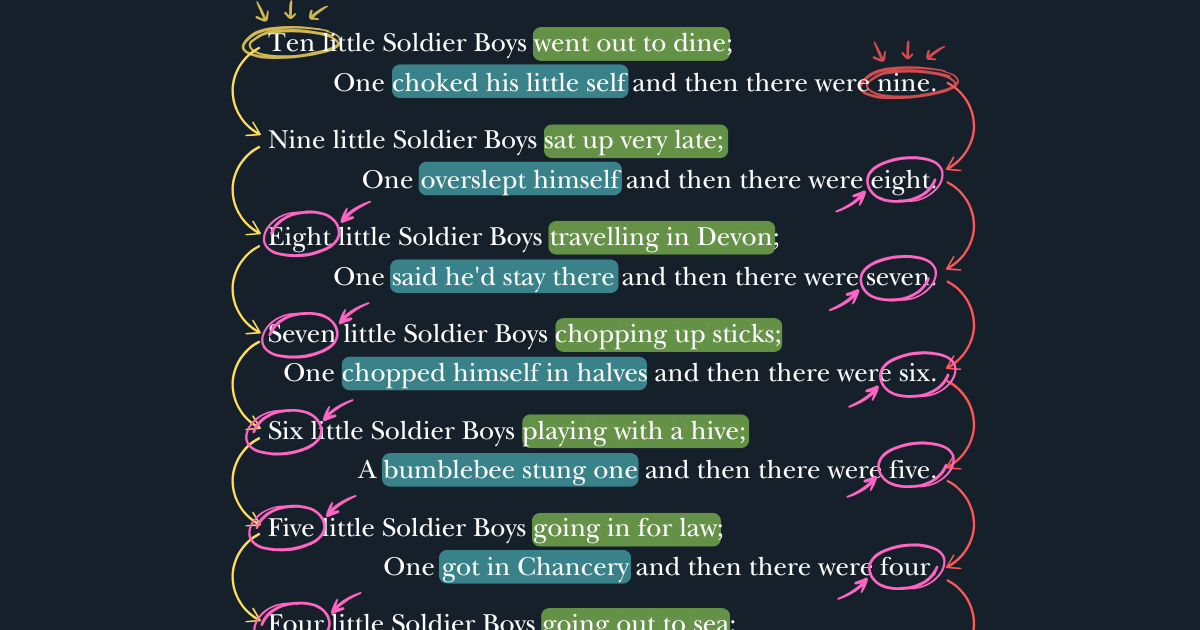
As usual, here's the passage we'll be analyzing from Agatha Christie's 1939 novel "And Then There Were None". It's a fun one in my opinion. And a useful literary device to master as you can sneak it into more than just mystery novels. But before we look at others, we might as well join these Soldier Boys and see what all the suspense is about.
Ten little Soldier Boys went out to dine; One choked his little self and then there were nine.
Nine little Soldier Boys sat up very late; One overslept himself and then there were eight.
Eight little Soldier Boys travelling in Devon; One said he'd stay there and then there were seven.
Seven little Soldier Boys chopping up sticks; One chopped himself in halves and then there were six.
Six little Soldier Boys playing with a hive; A bumblebee stung one and then there were five.
Five little Soldier Boys going in for law; One got in Chancery and then there were four.
Four little Soldier Boys going out to sea; A red herring swallowed one and then there were three.
Three little Soldier Boys walking in the zoo; A big bear hugged one and then there were two.
Two little Soldier Boys sitting in the sun; One got frizzled up and then there was one.
One little Soldier Boy left all alone; He went out and hanged himself and then there were none.
Once you've clocked this one down, join me below. Here's what I came up with.
One of the most common ways to infuse a story with suspense is with a countdown. Whether it’s a literal bomb set to sterilize half of the human race or the number of contestants left in the Hunger Games, countdowns are the quintessential way to put your reader on the edge of their seat. That said … not all timebombs are equal. Some stop ticking when they hit “zero”. Others, are still ticking eighty-six years later.
Enter Agatha Christie’s And Then There Were None and her creepy nursery-rhyme timebomb.
Pairing the innocence of children with the horror of death is a common trick adopted by horror enthusiasts. It’s designed to shake the reader and once we’re unsettled, every tick on the clock compounds.
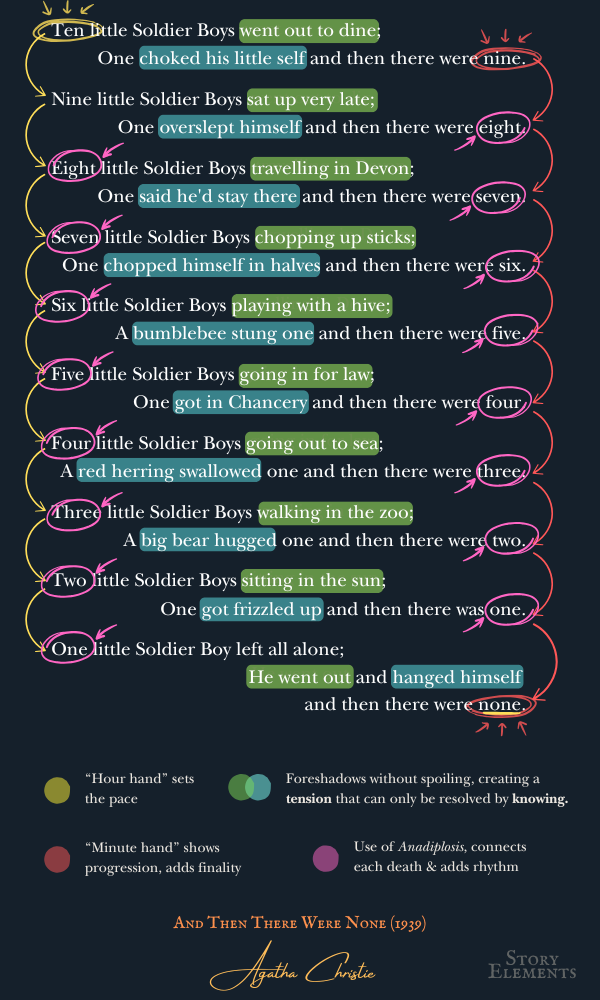
Christie structures each death around a countdown. The first number is like the hour hand on a clock and sets the pace, while the second functions as the minute hand. They both show progression, but the latter also adds finality to each death. It’s a trigger. And together, each section feels like its own little timebomb within the larger one.
But the crafty Christie doesn’t stop there.
She uses anadiplosis—starting the next sentence with the last word of the previous sentence—to “reset” the clock for the next death. By doing so, she creates a relentless and inescapable rhythm, a pattern we quickly begin to expect, and one that prompts us to know the words before we’ve heard the entire nursery rhyme.
And then there were “X”. “X” Little Soldier Boys …
The use of anadiplosis makes each death feel like it triggers the next. Even if no real connection exists. This turns the story from a mystery into an unfolding prophecy, and since prophecies are inevitable, this shifts everything. It’s not about if the characters will die, it’s how and when.
Funny enough, we know how they’ll all die. Yet, we don’t.
Christie gives enough away to spark our intrigue without spoiling anything. Even the prophesized deaths like “he went out and hanged himself” have unanswered questions. And unanswered questions create unresolved tensions. Ones we can’t put to rest until we know how they turn out.
A mix of certainty and uncertainty is part of her timeless formula. If we felt hopeless to solve any of the deaths ourselves, we might just lose interest and give up. But the certainty of some and complete uncertainty of others, gives us hope and keeps us locked in.
It’s that deeper understanding of storytelling: write enough to spark interest and create “negative” space where the reader can imagine the outcome. In other words, building a timebomb is a social activity.
So, want to make your timebomb tick long after it’s gone off? Give it an “hour hand” to set the pace and a “minute hand” to show progression. Make it feel inevitable. Remind the reader that the clock is ticking and that there’s no way to stop it. But give them a little hope that they just might find a way.
Related Articles: Coming Soon.